Pre-Submission
Consistency Review
A fixed-fee, independent check that the documents in a decommissioning submission reconcile with each other and with published requirements, carried out before a gate rather than after a query.
What it is
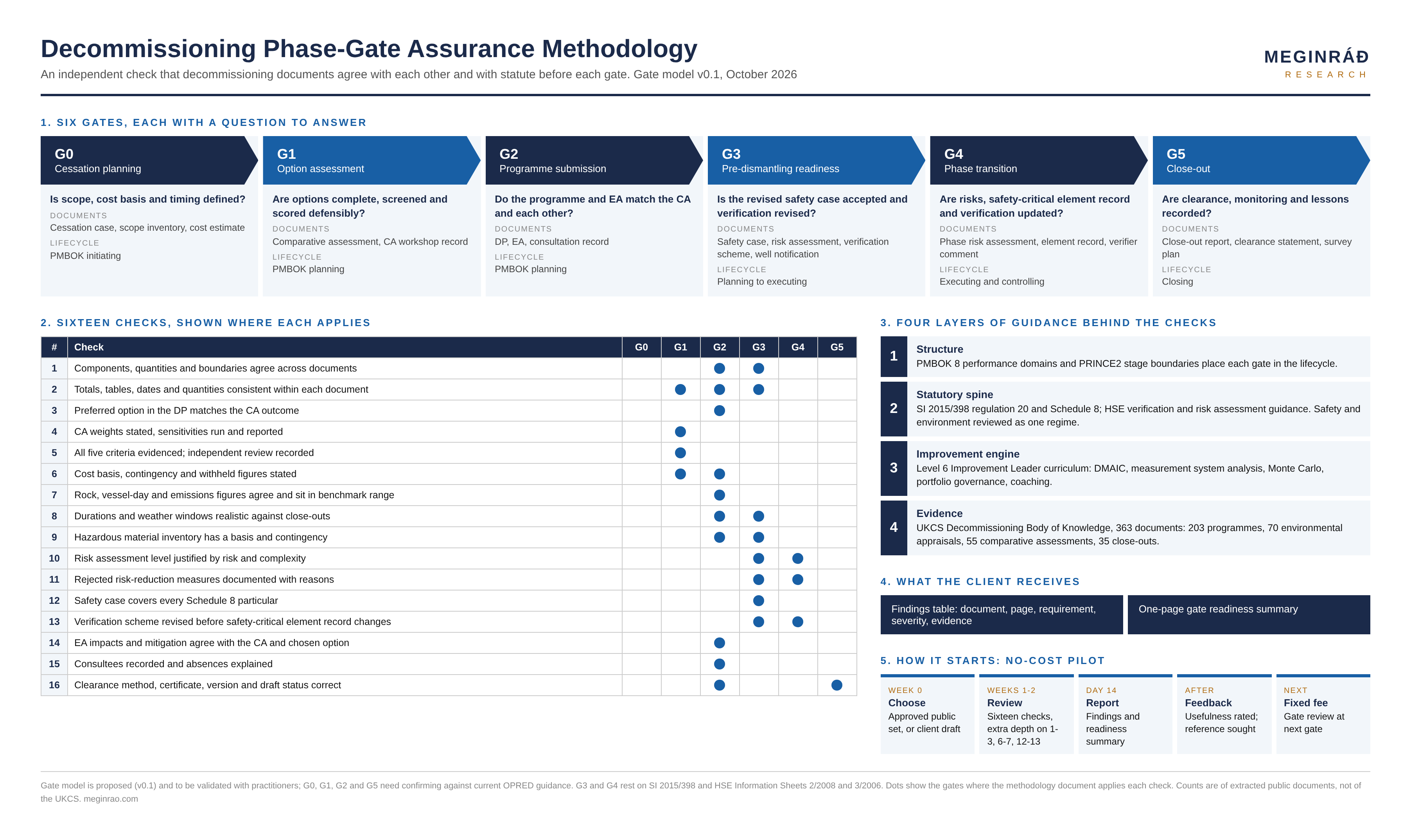
We read the documents that make up your submission as one set. Sixteen checks look for places where the documents disagree - quantities, boundaries, options, costs, dates and figures - and for places where a published requirement is not visibly met.
The output is a findings table you can hand to the document owners, and a one-page readiness summary for the gate.
Who it is for
Operators’ decommissioning teams: programme leads, regulatory and environmental leads, and those who sign off a submission and want an independent set of eyes on its consistency first.
Examples of the checks
- Components, quantities and boundaries agree across the DP, CA, EA and safety case.
- The preferred option in the programme matches the comparative assessment outcome; any departure from the lowest-scoring option is explained.
- Cost basis, contingency and withheld figures are stated.
- Rock, vessel-day and emissions figures agree between the CA and the EA.
- The dismantling safety case covers every Schedule 8 particular.
- The verification scheme is revised before the safety-critical element record changes.
The gate model (version 0.1)
Six gates, each with a question the documents should be able to answer. The model is proposed and is being validated with practitioners.
| Gate | Name | Question at the gate | Main documents |
|---|---|---|---|
| G0 | Cessation planning | Are the decommissioning scope, cost basis and timing defined? | Cessation case, scope inventory, cost estimate |
| G1 | Option assessment | Are the options complete, screened and scored defensibly? | Comparative assessment, CA workshop record |
| G2 | Programme submission | Do the programme and environmental assessment match the CA outcome and each other? | DP, EA, consultation record |
| G3 | Pre-dismantling readiness | Is the revised safety case accepted and the verification scheme revised? | Safety case, risk assessment, verification scheme, well notification |
| G4 | Phase transition | Before each substantive phase, are risks, the safety-critical element record and verification updated? | Phase risk assessment, element record, verifier comment |
| G5 | Close-out | Are seabed clearance, monitoring commitments and lessons recorded? | Close-out report, clearance statement, survey plan |
Gates G0, G1, G2 and G5 are being confirmed against current OPRED guidance. Gates G3 and G4 rest on the Offshore Installations (Offshore Safety Directive) (Safety Case etc.) Regulations 2015 (SI 2015/398) and HSE Information Sheets 2/2008 and 3/2006.
What you receive
No-cost pilot
Sixteen checks over two weeks on one approved public document set - for example, one of your own approved programmes - with a findings table and a one-page readiness summary. It shows what the review looks like on a real submission before you commit to anything. Scope and timing are agreed in a short call.
Request a PilotLimits
- It is not a regulatory approval, a safety verification or an engineering design review.
- It does not replace the independent verifier or the duty holder’s own assurance.
- It compares documents with each other and with published requirements; it does not assess whether a chosen option is the right one.
- The document extraction behind the context notes is a structured first pass; its accuracy against a hand-checked sample has not yet been measured.
The checks draw on the Knowledge base: a Decommissioning BOK, a Regulatory BOK and a regulatory checklist. Further detail, including the evidence base and its limits, is in the Practitioner Guide and the Theoretical Guide (PDFs).